Sunday, August 02, 2015

The Cat’s Still Alive (and Dead)! — Schrödinger Sessions

Not really Schrödinger's cat, but she is in a box.
I’ve just come back from an incredible weekend at the Schrödinger Sessions: Science for Science Fiction, at the Joint Quantum Institute at the University of Maryland, near Washington, D.C. The JQI staff hosted just over a dozen SF writers, and for several days stuffed our heads full of information about quantum physics. It was head-exploding. But in a good way!

Here are some of the things we learned from Chad Orzel, Steve Rolston, Chris Monroe, and others:
  • How to become quantum (which only works if you are very small, much smaller even than I was when I was at my low weight).
  • How (if you can master the first step) you can be in two places at one time—and also how to collapse that state so that you’re just in one.
  • How to trap a single charged atom (ion) in a vacuum trap and cool it to just a whisker above Absolute Zero. (And we leaned over and didn’t touch! equipment that does just that.)
  • How to quantum-entangle two or more particles in the above-mentioned apparatus. (Okay, I still don’t really understand how to do that.)
  • How to make light disappear with two polarized filters, and reappear with the addition of a third. (I sort of understand that.)
  • That sometimes the answer to the question “Why?” is “Just shut up and calculate.”
  • That probability is not a definition of a thing, but a statement of our knowledge of a system.
  • That probability is not a definition of knowledge after all, but of our ignorance about a system.
  • That there are two rules of quantum mechanics:
  1. Quantum objects are waves, and can be in states of superposition (more than one position at a time).
  2. Rule #1 holds as long as you don’t look!
Professor James Gates (familiar from countless PBS documentaries) told us why he doesn’t buy the extra dimensions suggested by most string theorists.
Professor Raman Sundrum (of the Randall-Sundrum Model) told us why he does, and furthermore why it’s possible we’re living in a holographic universe.

I learned that quantum physicists say "I don't know" a lot.

There was tons more, presented by a bunch of professors. I hope I can remember it. Or most of it. Or some of it.

Part of it, in fact, plays right into what I’m trying to do in The Reefs of Time. So I really hope I can remember that part.

Maybe I’ll buy the book by Chad Orzel, one of the workshop leaders, How to Teach [Quantum] Physics to Your Dog.

Down in there is a glowing cluster of verra verra cold ytterbium atoms.  
 

Labels: , , ,

Tuesday, June 30, 2015

Happy Asteroid Day!

Yes, today is Asteroid Day, intended to heighten our awareness of our planet’s vulnerability to assault by Nature, in the form of asteroids that could smack us and reduce cities—or even civilization itself—to rubble. The threat is not imminent, perhaps, but it’s certainly real. And some of our agencies are starting to get serious about planning ways to protect ourselves.

Proposed methods of diverting asteroids range from painting one side of a threatening asteroid white (to change the balance of sunlight pressure and outgassing), to using ion traction motors, to repurposing something else that threatens our world: nuclear weapons.

I like to think of this day as also celebrating the opportunity to do cool and constructive things with asteroids, like mining them for water and metals, and hollowing them out to live in them. We’re working on that, too. 

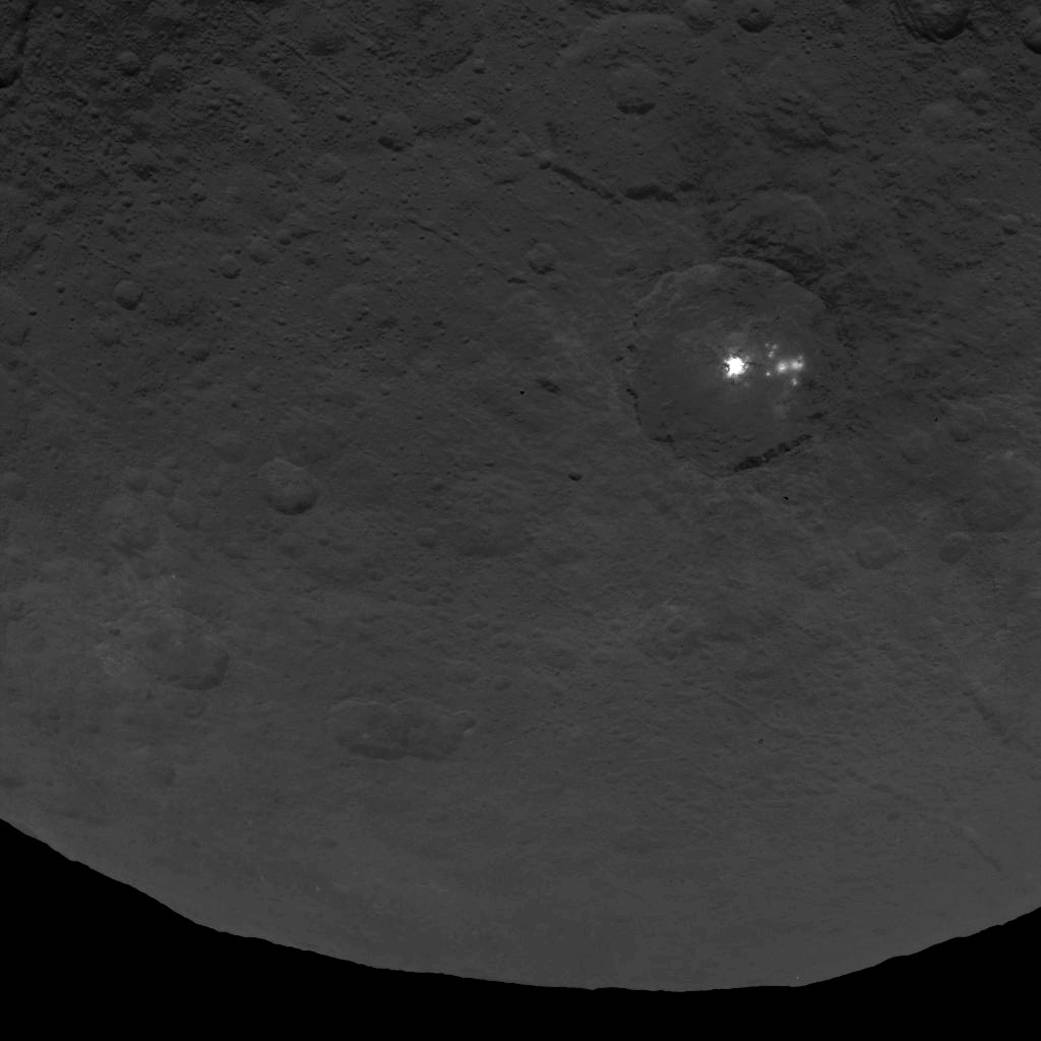
Meanwhile, I’ll leave you with a picture of the biggest asteroid in the inner solar system, Ceres, currently being orbited by the Dawn spacecraft—and its mysterious white spots. Alien winter Olympics? Alien ice cream stands? I guess we’ll find out together.


Labels: , , ,

Tuesday, June 16, 2015

Spot the Robodog Isn’t Herding Sheep. Yet.

Spot isn’t Captain Jack, but it’s still pretty nifty. Check out this robot from Boston Dynamics (now owned by Google), running through its paces.


More about Spot and his siblings here: The Guardian

Labels: , ,

Friday, October 31, 2014

Spaceship Two Crashes on Test Flight

This has been a wrenching week for space enthusiasts, and especially space entrepreneurs. I just read the heartbreaking news that Virgin Galactic’s Spaceship Two exploded during a powered test flight today, killing one of the two pilots and seriously injuring the other. (This follows the explosion, a few days ago, of Orbital Science’s Antares cargo rocket, on liftoff for the International Space Station.) Both were privately funded space ventures.

Spaceship Two, of course, was slated to carry paying passengers on brief excursions into space (suborbital, not orbital). It is the offspring of Spaceship One, which a few years ago won the Ansari X-Prize for being the first privately funded craft to reach space, and to turn around and do it again a short time later. Spaceship One was funded largely by Microsoft’s Paul Allen, while Spaceship Two is funded by Sir Richard Branson, founder of Virgin Atlantic and Virgin Galactic.
 

Spaceship Two after release from White Knight Two. LA Times photo


Spaceship Two explodes soon after. LA Times photo

What this means for the future of Spaceship Two is not yet clear. It was flying with a new fuel today from that used in previous test flights. Perhaps that caused the rocket engine to explode, or perhaps not; it’s too soon to know.

As we’ve heard more than once from those who know a lot more than I do, “Space is hard.” There will be accidents. My heart goes out to those hurt by this one, the pilots and their families and friends, and all of those associated with this venture. But I’m going to echo here a quote that my colleague Geoff Landis echoed from someone else on Facebook:

"It is not the critic who counts; nor the one who points out how the strong person stumbled, or where the doer of a deed could have done better.

The credit belongs to the person who is actually in the arena; whose face is marred by dust and sweat and blood, who strives valiantly; who errs and comes short again and again, because there is no effort without error and shortcoming; who does actually strive to do deeds; who knows the great enthusiasms, the great devotion, spends oneself in a worthy cause; who at the best knows in the end the triumph of high achievement; and who at worst, if he or she fails, at least fails while daring greatly.

Far better it is to dare mighty things, to win glorious triumphs even though checkered by failure, than to rank with those timid spirits who neither enjoy nor suffer much because they live in the gray twilight that knows neither victory nor defeat."

— Theodore Roosevelt
This is how I will remember Spaceship Two:

Spaceship Two during an earlier, successful test flight. LA Times photo


Labels: ,

Wednesday, October 29, 2014

Another Flying Car on the Horizon!

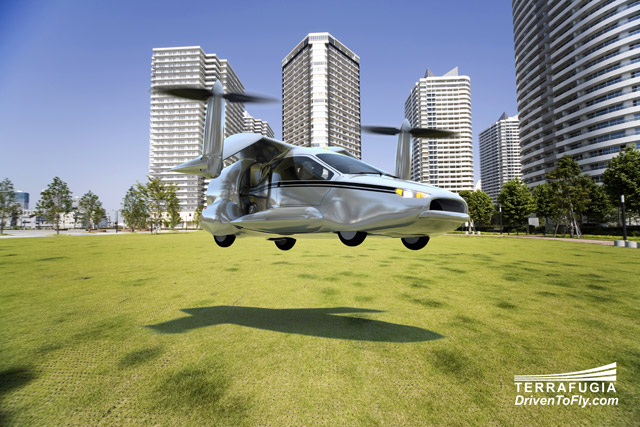
This story made me immediately think of my Slovenian-made moped, a Tomos. Well, the wily Slovakians are giving my neighbors the Terrafugia people a run for their money on the race to develop a practical flying car. (A race that’s been on for, what, sixty or seventy years? About as long as the race to develop practical fusion power.)

Take a look at this beauty, the Aeromobil 3.0.


(Best viewed at full-screen size.)
View on Washington Post

Estimated to cost only a few hundred thousand dollars! (But I’ve already got the pilot’s license, so I’m partway there.) Woo-hoo!


Labels: , ,

Antares Explosion

I’ve written from time to time about the encouraging progress being made in privately funded efforts to get us into space. SpaceX has certainly had some great successes lately. And so has Orbital Sciences. But I suppose I should note the bad along with the good. This failure of the Antares cargo rocket bound for the ISS, yesterday, had to be a huge blow to the folks at Orbital Sciences. But thankfully no one was hurt.


It’s yet another reminder that space travel isn’t easy, and won’t be for a long time to come. Let’s hope they can find the cause of this, fix it, and get back onto the Star Road. Because as Tsiolkovsky said, we can’t live in the cradle forever.


Addendum: The Antares rocket was powered with refurbished Soviet-made rocket engines. This in itself isn't unusual, since several of our major launch vehicles, the Atlas and Delta, are now powered by Russian-made rocket engines (though I believe of a later design). Whether this is a good idea or not is an entirely different question.

Labels: , ,

Wednesday, October 01, 2014

3D Printing Now—and Then

I was reading recently about the delivery of the first 3D printer in space to the International Space Station, by the SpaceX Dragon cargo spaceship. You can read all about it here, and it’s pretty cool.

Not long after, I was reading a piece of fiction I’ve had around for a while that included this paragraph:

Igor’s countrymen, though lacking many earth techniques, were far ahead of earth in manufacturing skill. They used a single general type of machine to manufacture almost anything. They fed into it a plan which Igor called for want of a better term the blueprints—it was in fact, a careful scale model of the device to be manufactured; the machine retooled itself and produced the artifact. One of them was, at that moment, moulding the bodies of fighting planes out of plastic, all in one piece and in one operation.
That’s from Robert Heinlein’s “Elsewhen,” first published in 1941. It’s included in the collection Assignment in Eternity.


That man had some vision. 

Labels: , ,

Saturday, October 12, 2013

Surplus Energy!

Yesterday was our first full day of generating power from our solar panels. It was a pleasant, mostly sunny day. I just checked our energy output for the day, and we seem to have generated a cool 30 kilowatt hours of current total. Here's the graph, peaking between noon and 3 p.m.:


According to a recent electric bill, last fall we used on average around 20 kilowatt hours per day. I have no way of checking directly, but if that pattern still holds, we generated half again as much electricity yesterday as we used. We sold power to the grid!

Power too cheap to meter! Power from the people!

Labels: , ,

Thursday, October 10, 2013

IT'S ALIVE!!! Bzzzz-t-t-t!

Our solar panels went live today, shooting electricity to to the grid! And to us! Time to celebrate!

Besides saving the Earth, we have a new way to waste time: logging in to see exactly how much power we're generating (12 kwh for the afternoon, the last time I checked). It's a cloudy day, and we were already past peak sun when the switch was thrown. I hope we get a sunny day this weekend, so we can stand around and look at the meter.


The switch is ON!


Fun fact: While the technician was showing me the website, a graphic informed me that we had, in effect, charged 4400 AA batteries since he'd switched it on. Or charged 2500 cell phones. Or burned a gallon of gas, but without the carbon emissions.

Solar rocks.


So does this movie.

Labels: , ,

Tuesday, September 24, 2013

Solar Panel Installation – Pt. 2

If a picture is worth a thousand words, I've just done my day's writing, and tomorrow's and the next day's, as well...


It's all done, except for the final inspections—first by the town inspector, and then by Nstar. After that, we throw the big red switch, and electricity starts flowing from the rooftop!

Update Oct. 3 -- The inspection is done, and now we're just waiting for Nstar to sign off on the paperwork. I'm told that can take anywhere from ten minutes to two months, but averages a week or two.


Labels: , ,

Thursday, September 19, 2013

Solar Panel Installation – Pt. 1

For the past three days, a crew of two men from Solar Flair Energy has been working on our house, preparing the installation of rooftop solar panels. So far, they've got the framework up on the roof, and part of the wiring in the attic. They should finish off the job by Monday, after which the town inspector and the Nstar inspector have to sign off on the installation. And then, we go live with power from the sun!

Here's what we've got so far.


What makes this feasible is a combination of tax credits and a mind-twisting system of utility rebates (called SRECs) for renewal energy. It's a substantial upfront investment from us, with a projected payback period of 7-10 years, after which it should start earning us money as we feed electricity into the grid (whatever we generate beyond our own needs). It should lower our energy bills, while reducing our carbon footprint, dependence on fracking and foreign oil, contribution to nuclear waste, and so on.

It's all part of a program called Solarize Arlington, in which residents and business owners in town joined together with one provider to gain quantity discounts on the solar panels and other equipment. Other towns in Massachusetts are following suit. Our installer told me today that they've got jobs ahead of them as far as the eye can see.

Stay tuned!

Labels: , ,

Sunday, September 15, 2013

Fusion Power from Skunk Works?

Ever since the 1950s, the promise of unlimited power from controlled nuclear fusion has been just around the corner—or, to be more precise, about fifty years in the future. It's still fifty years in the future, according to most experts.

Well, the people at Lockheed Martin Skunk Works (creators of the famed SR-71 Blackbird spy plane), say they're going to do it a lot faster. Here's a talk by Charles Chase, of the Skunk Works. You can skip the first half of it, if you know more or less what fusion research is all about.


A lot was left unsaid, obviously, such as how close they have come to break-even—i.e., more energy coming out of the system from fusion reactions than is being put in. I'm skeptical of the claim, myself, but I would love to be proven wrong. For one thing, the application to space travel could be fantastic.

I guess we'll wait and see. Usually the Skunk Works doesn't advertise what they're up to. Why is this different?

Labels: ,

Thursday, May 09, 2013

The Yin-Yang of Technological Advance

Lots of interesting stuff has passed across my desktop since I got back from P.R., but the contrast of these stories really struck me:

First, we have a micro-satellite from Tartu University in Estonia, just launched into space on a European Vega rocket, designed to test an innovative new design to harness solar protons for propulsion, by repelling them. It's interesting to see something like this come from a first-time space-faring country like Estonia. It'll be even more interesting if it works. The concept might help us explore the solar system.


If we don't kill ourselves first, that is. Our second, and definitely yang entry, is a plastic handgun made almost entirely in a 3D printer. Just what we need, handguns that may be undetectable by existing screening methods.


But then again, let's cheer ourselves up with news that the flying car continues to approach reality (if not affordability). In fact, Terrafugia, creators of the soon-to-be-released Transition flying car, announced recently that they're now working on a vertical takeoff and landing model, so you could theoretically take off in your driveway and land in a parking lot. Whee!


Labels:

Friday, October 19, 2012

Low Tech and High Tech

Man constructs working bicycle from cardboard. It looks great. How cool is that? 


On the high-tech side, Google opens its server farms for us to goggle over. Click here for a great gallery view of caves full of servers, cooling pipes, wires.


Labels:

Wednesday, September 26, 2012

The Majestic Soaring of Spaceship Two


Here's a lovely video of some flight tests of Virgin Galactic's and Scaled Composite's Spaceship Two. I meant to post this a while back, but I don't think I ever did. Anyway, it's worth watching twice!


Labels: , , ,

Thursday, June 07, 2012

To Mars Via Reality TV?


I wonder what Ray Bradbury would have thought of this. The Mars-One project proposes to send permanent (for the rest of their lives) colonists to Mars, funding coming from reality TV coverage:


View on youtube


They've got Nobel Prize-winning physicist Gerard 't Hooft on board. More on the story from NBC News. I wonder what Robert Zubrin of the Mars Society thinks of it.


Labels: , , , ,

Friday, May 18, 2012

Mind Control

Mind over machine. Science fiction has predicted for decades that one day we would be able to control things by hooking our brains up to computers that would just make it all happen. And now it has happened: a paralyzed woman has used her mind to control a robot arm and make it bring a coffee cup to her lips to drink. This is not just cool; it is a promise of incalculable benefit to severely handicapped people everywhere, hopefully in the not-too-distant future.


The work was developed by scientists at Brown University, the Providence VA Medical Center, Harvard Medical School and other institutions. The AP story gives more information.

Labels: , ,

Wednesday, May 09, 2012

I wish my Roombas could do this!

Especially the one I have to fix since it tried to sled down a flight of stairs on a piece of loose carpet. Here is the FirstLook, from iRobot.


Labels: ,

Thursday, April 26, 2012

Mine the Asteroids!

The gold rush has officially begun: the mining of the asteroids. Science fiction writers have been predicting it for decades.* Now some seriously hard-hitting billionaires and technical people are joining forces to make it happen, through a privately funded initiative called Planetary Resources, Inc. Investors include filmmaker and explorer James Cameron (yes, he who just dove the Mariana Trench), the founders of the X-Prize Foundation, Google executives Larry Page & Eric Schmidt, Ross Perot, Jr., and others. Technical people include—well, for example, the chief engineer is Chris Lewicki, who was Flight Director for NASA’s Spirit and Opportunity Mars rover missions.

They're seriously planning to robotically explore and mine near-Earth asteroids, seeking precious metals, such as platinum-family metals, and water (very precious in space, very expensive to lift into orbit). From the Planetary Resources website:

"Initial space resource development will focus on water-rich asteroids. Water is the essence of life and exists in plentiful supply on asteroids. Access to water and other life-supporting volatiles in space provides hydration, breathable air, radiation shielding and even manufacturing capabilities. Water’s elements, hydrogen and oxygen, can also be used to formulate rocket fuel."

Here's a summary of a recent report suggesting that the technology to do this is available or nearly so. 

I think this is one of the most exciting developments in space exploration since the Apollo lunar landings. For more details, visit the Planetary Resources website. For a highly readable but expert analysis, read Phil Plait's Bad Astronomy blog post: Breaking: Private company does indeed plan to mine asteroids… and I think they can do it.

I'm not an investment speculator, but if they were selling shares, I'd be in for a share today.

*My own short story, Dog Star, is based on the premise that we'll be actively mining near-Earth asteroids; also, on the smarts of border collies.

Labels: , , ,

Wednesday, March 28, 2012

Cameron Dives the Mariana Trench!

Filmmaker James Cameron (Avatar, The Abyss) has become the third human in history to travel seven miles down into the deepest part of the ocean—the Challenger Deep, in the Pacific Ocean's Mariana Trench. He's the first to do it alone, as leader of the Deepsea Challenge mission.


I was eleven when the Trieste made the first, two-man, dive in 1960. I've often wondered why nobody ever went back (just as I've wondered why we haven't returned to the Moon). Well, now this team has done it, and it's the first of a planned series of dives. Whereas the Trieste got just twenty minutes of bottom time and never returned, Cameron and the submersible Deepsea Challenger spent a couple of hours there, gathering samples and shooting 3D video. Here's the first of many video clips about the National Geographic sponsored mission:


When I blogged, just days ago, about two separate planned expeditions, I had no idea that Cameron's dive was imminent. And I almost missed it when it happened. The story was buried in the Boston Globe, and it's too early for it to be in any of my science mags. In my previous forays to the Deepsea Challenge site, I'd failed to notice the prominent box where you can sign up for email updates. I've fixed that. But I can't help wondering: Why aren't stories like this front-page news? If I were running the world, they would be! Because, by God, this is exciting stuff. What a time to be alive!

Labels: , ,