Wednesday, June 24, 2015

James Horner, 1953 – 2015

Another heartbreaking loss for film and music lovers. Composer James Horner died in a small plane crash north of Santa Barbara last Monday. He was 61.

James Horner was right up there with John Williams and Jerry Goldsmith in my pantheon of beloved composers. I first fell in love with his music with the scores for two of the best classic Star Trek movies, The Wrath of Khan and The Search for Spock. Just as the second movie built on the first, so too did the music, adding depth and texture to the themes introduced in Khan. There was a nautical flavor to the themes, evoking the wonder and peril of deep space like nothing else I had heard.

His credits included Aliens, Titanic, Avatar, Apollo 13, Braveheart, A Beautiful Mind, and countless other films. He was by all accounts a man of extraordinary generosity.

James Cameron, in a tribute in Hollywood Reporter, recalls beginning work with Horner on the score for Titanic:
I asked if he could write some melodies. I believe that a great score really consists of something you can whistle. If that melody gets embedded in your mind, it takes the score to a different level. I drove over to his house and he sat at the piano and said, “I see this as the main theme for the ship." He played it once through and I was crying. Then he played Rose’s theme and I was crying again. They were so bittersweet and emotionally resonant. He hadn’t orchestrated a thing, and I knew it was going to be one of cinema’s great scores. No matter how the movie turned out, and no one knew at that point — it could have been a dog — I knew it would be a great score. He thought he had done only five percent of the work, but I knew he had cracked the heart and soul.
Of all of them, though, his haunting score for The Search for Spock is the most memorable to me, and one I’ve listened to countless times while writing.

Farewell, James Horner. May you continue to fill the heavens with your splendid music!

Labels: , ,

Saturday, February 28, 2015

Losing Leonard Nimoy Is Hard. Losing Spock Is Even Harder.

The passing of Leonard Nimoy at age 83 saddens me in much the same way that losing Neil Armstrong did, back in August of 2012. (Has it really been two and a half years?) Armstrong was a space pioneer. Nimoy created the role of a space-fiction pioneer. And both carved lasting places in my heart, and in my view of the world and the century I’ve lived in.


I never knew Nimoy personally, but I do feel that I know, and love, Spock. As a science fictionally literate teenager, my initial reaction to Star Trek in its original 1960s run was that the pointy ears and walled-off emotions were pretty cheesy and unoriginal. But Spock grew on me with time, as did all of the Trek characters. It wasn’t until years later, after countless viewings of the reruns, that I came to appreciate Nimoy’s acting, and to realize that it was Enterprise family I loved, more than any of the much-touted forward-thinking virtues of the show (though those were good, too). And at the heart of the family were Spock and Kirk, with Spock possibly at the heart of the heart. Later came the movies, and the death and rebirth of Spock, and that’s when he really came into his own as a character, and as a friend in my own mind.

We’ll always have Spock with us, of course. And in his own way, Leonard Nimoy will always be with us, even as he journeys now in the beyond. But we’ll never again get to see him play Spock in something new. And that, in a way, is what hurts the most.

Godspeed, Leonard Nimoy. Live long and prosper. And thanks for all that you’ve given us.


Labels: ,

Monday, June 02, 2014

Gene Soccolich, 1946 - 2014

Scattering the ashes of a friend is not my preferred way to spend a sunny afternoon. And yet there was camaraderie and healing in it last Saturday, when Allysen and I joined with my friend's family and another friend in saying good-bye to Gene Soccolich, who died a week ago of heart failure.

I first met Gene in 1973, when I was heading to the University of Rhode Island to attend a one-year graduate program called Master of Marine Affairs. A mutual friend put us in touch, because Gene was doing the same thing. We rented a place together in Jamestown, RI, on an island in the mouth of Narragansett Bay. For nine months, we lived in one of the nicest places I've ever lived in—a glass-fronted summer home overlooking the water, with spectacular sunsets behind the bridge to the mainland. There I introduced him to Star Trek reruns (which did not entirely take), and he introduced me to Pink Floyd's Meddle album (which did). I sometimes kept him awake typing on my portable typewriter—at least at first, and then he started waking up if I wasn't typing. He liked to tell people of the time he lay awake waiting for the typing to resume: After a minute of silence, he heard a single keystroke, and then, "Shit!" (I was a poor typist.)

In the years that followed, I went on to become a struggling writer, and he worked first in state government, and then in the high-tech computer industry. Oddly, he barely knew how to turn on a computer himself, though he facilitated million-dollar deals involving the technology. His expertise was in making such deals, which he did by getting people to talk to each other about what they really needed in a product, service, or business partner. He had a remarkable ability to cut through the B.S. (though he could sling a pretty good line of it himself when he wanted to).

He was married for a time, and had three great kids, all adult now. We used to see them during happier days, and then for a time we didn't. Gene's later health and financial troubles brought me back in touch with his kids, which is one of the things I'm most grateful for, here at the end.

Gene had lousy genes, when it came to cardiovascular issues. His first heart operation in his forties was just the start. By the end, he'd had his aorta replaced with a Dacron tube, after a ballooning aneurism threatened to drop him in his tracks. (His sister Christina, a rising literary star, had her own career cut short by a brain aneurism that robbed her of the ability to write.) Divorce, loss of work, poor health, and depression led to a very difficult life for Gene in the last ten or fifteen years.

But even while drawing inward and becoming ever more isolated, Gene began writing a novel. Initially he titled it American Spit, but later changed it to Waking Up Down East, which I thought was better, more reflective of the book's redemptive ending. He asked me long ago if I would please try to find a way to get it into print, if he was gone before he did it himself. I said I would, so that's something I'll be working on in the future.

In meantime, though, it was uplifting and healing to spend time with his two sons and one daughter, his sister, and his other good friend Bruce. His ashes went to sea from a gorgeous outlook on the coast north of Boston. Gene always loved the sea, and it seemed a fitting place to say good-bye. Godspeed, old friend.


Labels:

Tuesday, September 03, 2013

Frederik Pohl, 1919-2013

We've lost another giant—maybe the last of his generation of Golden Age science fiction. Frederik Pohl, along with Clarke, Heinlein, and Asimov, occupied a central position in my formative years as a lover of science fiction. More than any of the others, he kept growing in maturity and ambition as a writer—showing a burst of enormous creativity in his late 50s, with two of his finest books, Man Plus (1976) and Gateway (1977). I consider Gateway one of the top five books in all of science fiction, and I'm not sure what the other four would be.


I first encountered his work, I believe, in The Space Merchants, which he coauthored in 1953 with C.M. Kornbluth. (I didn't read it in 1953; I was only four years old at the time. I started reading him in my teens.) I still have many old paperbacks of his earlier work on my shelf. Just scanning a list of his titles evokes all kinds of feelings of golden-age sense of wonder: Search the Sky, Gladiator-At-Law, Drunkard's Walk (which I was especially fond of as a teenager because of the tastefully drawn naked woman on the cover), Starchild, Rogue Star, Turn Left at Thursday, Starburst, The Siege of Eternity, The Case Against Tomorrow....

And yes, the title of my own work in progress, The Reefs of Time, is a knowing echo of his The Reefs of Space.

Pohl did just about everything there was to do in the SF world. He was an editor (Galaxy magazine), an agent, a solo writer, a collaborative writer, a futurist, a columnist and blogger, a president of the Science Fiction Writers of America, and a SFWA Grandmaster. He was also a perfect gentleman, and a fascinating speaker. I only met him once or twice, but he treated me, a fresh upstart, with graciousness and warmth.

You can read more about his life and work at the New York Times and the Guardian.

I hope he's enjoying a perfect view of the stars from where he is right now, perhaps sitting around a table with some of the other departed greats, in the observation lounge of a heavenly starship. Godspeed, Frederik Pohl, and thank you for all of the visions.


Labels: , , ,

Friday, April 05, 2013

Another Loss: Film Critic Roger Ebert, at 70

I've never been a regular reader of the Chicago Sun-Times, but when it comes to checking reviews of movies I might be interested in (especially movies that show up on cable), the first reviewer I check is always Roger Ebert. I've trusted his reviewer's eye and sensibility ever since I first encountered him with Gene Siskel, on Sneak Previews, on PBS. He died yesterday at age 70, after a long struggle with cancer. The Sun-Times has a detailed obituary, and Blastr has one that focuses more on his interest in science fiction. He was a lifelong SF fan, as well as a  perceptive reviewer of movies of all genres.

Along with millions of other moviegoers, I'm sure, I mourn his passing. But I'm grateful for the legacy he's left us of intelligent, compassionate, critical thought about the movies. I'll keep checking for his reviews as long as they leave them up on the web.


Labels: , ,

Saturday, August 25, 2012

Neil Armstrong, 1930 – 2012


A giant of a man died today, and I feel great sadness, even as I celebrate my own birthday. Neil Armstrong has left us.


I remember it like it was yesterday: July 20, 1969, holding my breath as the Apollo 11 Lunar Module finally landed on the Moon, with Neil Armstrong at the controls. And then, some hours later (late at night in Huron, Ohio), watching the grainy black and white TV images of Armstrong, and then Buzz Aldrin, stepping onto the surface of the Moon. I knew then that the world would never be the same, and that history would forever be divided between the time before humanity walked on another world, and after.

Neil Armstrong steps off the Eagle

Neil reads the plaque declaring that Apollo 11 has come on
behalf of all Mankind.

A defining moment for humanity, but also one for me personally. Many of my friends lost interest in the space program soon after, but I never did. To me it was, and will always be, one of mankind's grandest adventures.

Others will write more knowledgeably of Armstrong's life and career. But I'm pretty sure of one thing: a thousand years from now, if we're still around, the name Neil Armstrong is one that people will remember.

One small step... and another, and another. Godspeed, Neil Armstrong.

Bootprint on the Moon

Labels: , , , ,

Tuesday, July 24, 2012

Sally Ride, 1951 – 2012

America's first woman astronaut died Monday at the age of 61, of pancreatic cancer. Sally Ride was an inspiration to millions, and not just girls and women. I remember what a triumph it felt to me, back in 1983, when she rode Challenger into space, ending once and for all the perception that American space travel was solely the domain of men. Nowadays, women fly missions all the time, and sometimes command them. It's easy to forget that as recently as the early 1980's, women were simply not part of the NASA equation. The Soviet Union had sent a woman, Valentina Tereshkova, into space twenty years earlier, but that had not signaled a general welcome of women into the Soviet space program. In the case of Sally Ride, it really was the shattering of a glass ceiling. After the loss of Challenger in 1986, Dr. Ride was named to the presidential commission that investigated the cause of the tragedy. She later went on to found Sally Ride Science, an organization devoted to supporting girls’ and boys’ interests in science, math and technology.

Here was a woman who made a difference. It's sad to see her passing. Godspeed, Sally Ride.


Labels: , , , ,

Wednesday, June 06, 2012

Ray Bradbury, SF Master (1920 – 2012)


Ray Bradbury, the last of the Big Four in science fiction, died today. Over the years we've lost Robert A. Heinlein, Isaac Asimov, Arthur C. Clarke, and now Ray Bradbury. We've lost many other great writers, of course, but few would argue with placing those four at the top in their influence on the literature, and influence on young writers. It's like the passing of a Great Age in Middle Earth.

Bradbury was a master of the short form, and probably the first acknowledged science fiction writer to gain the respect of the mainstream literary world. (Probably because he was at heart really a fantasist more than an SF writer. He was also a remarkable stylist.) Did your high school literature book have any science fiction In it at all? If it did, it was probably by Ray Bradbury. "The Pedestrian," maybe. Or "The Veldt."

He wrote for the screen, as well. I'd been a fan of his fiction for many years before I discovered that he'd written the screenplay for the 1956 John Huston-directed adaptation of Moby Dick, with Gregory Peck and Richard Basehart.

I was one of probably thousands of young writers who found both encouragement and frustration in reading his work. (My favorites: The Martian Chronicles and Something Wicked This Way Comes.) The encouragement is from the delight in reading his visions. The frustration is from the illusion he cast that it was all so easy. He really made storytelling look simple. And that is a mark of a master. I never knew him personally, though I saw him a few times at Nebula Awards events. The last time, I think, was when I saw him accept his SFWA Grandmaster Award in... you know, I don't remember the year or the city, but I can see him inching his way up to the stage, with the assistance of his son, as though it were yesterday. Edit: I also remember that he had a sense of humor about his infirmity. When he finally got to the microphone, his words were, "Do you ever have the feeling that everyone's watching you?"

There's a fine remembrance at the Washington Post, and all kinds of interesting details on his Wikipedia page

Godspeed, Ray Bradbury!

Labels: , , , , , ,

Thursday, January 20, 2011

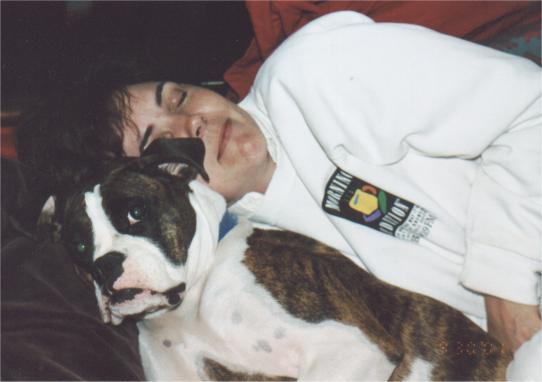
Our Dog Hermione 1999-2011

In a real shocker to the family, we lost our beloved boxer Hermione this morning—pretty much without any warning. Not quite twelve years old, she had seemed like a healthy, if slowing-with-age, dog. Just yesterday, I looked at her and thought, You're looking fit for your age. I hope we have you for a couple more years.

 Hermione, pretty much the way she always looked

This morning she staggered up out of her bed, stumbled, fell, and couldn't get up. She was dazed, and her lips and gums were pale. We got her to the vet as fast as we could, but the news was grim. An ultrasound showed a tumor on her spleen, with internal bleeding. Dr. Grosser, a lovely woman who has seen Hermione through several difficult situations, couldn't offer much hope. It would be possible to spend thousands (which we don't have) on surgery to try to buy her a few months. But she couldn't recommend it, even medically. Hermione's condition was likely to grow worse, not better. The doctor's recommendation was to put her to sleep before she went from dazed and helpless to being in a lot of pain. And that's what we did. All four of us were there—I'd gone to get Julia out of high school—and Hermione was aware of us being with her. She went peacefully.

About two minutes after she slipped away, Alexandra, our older daughter, changed abruptly from sobbing tears to a big smile and cried, "She's running!  I can see her.  She's happy!" I looked up at Alexandra and saw joy and recognition of something ethereal in her eyes. That vision for those few seconds transformed Alexandra on the spot and greatly comforted the rest of us.

Hermione was one of the sweetest-tempered dogs I've ever known. She didn't always like other dogs, but she never met a human who wasn't her friend. And she was supremely tolerant of her buddy Moonlight the cat, who would from time to time swat her for no apparent reason except to say hi. As a puppy, Hermione was almost ludicrously eager to please, but as she matured, she came to decide that life was not entirely about following instructions. We were always kind of glad about that.


Hermione and Moonlight, in younger days
The house feels strangely empty now. Moonlight seemed for a moment to sense that something was wrong, when we came home--but who knows what cats can understand? And I guess I'll have to get used to going on walks by myself now.

Labels: , , ,

Wednesday, November 03, 2010

Phil Palmer, We'll Miss You

My father-in-law Phillip Palmer died Sunday evening, in Ponce, Puerto Rico. He was 87. Allysen was down there at the time, and had visited him in the nursing-care home just hours before he died. She's there with her mom now, and with her brother Andrew, who's just flown in.

Phil was a wonderful guy, a lover of travel and good food and wine, who in his working life was an electrical engineer in international sales. It was thanks to that work that he and his wife Fay settled in Puerto Rico, a place they loved in their bones. Phil had a hard last few years—especially this final one, with several heart-attack trips to the hospital, and a rapidly declining ability to get around or to do the things he loved to do (home renovation projects, mostly). It's not that many years ago that he masterminded the lovely deck that's now on the back of our house here in Boston. He loved building things, and especially loved changing things.

Phil in 2007

I'll write more later. For now I need to focus on helping Allysen from a distance, and on getting the rest of us ready to go down there to join her for the memorial.

Labels: , ,

Wednesday, September 15, 2010

The Short, Sweet Life of Pippa

We buried a 5-month-old puppy yesterday. Her name was Pippa, and she weighed less than ten pounds. She came to us from Puerto Rico with Allysen, where she had been rescued and made briefly part of Allysen's parents' household. She was adorable and sweet and alert, probably part border collie but tiny.  We decided that she was of the breed Foxbat, or Borinquen terrier, and she captured all of our hearts. She made friends with Hermione, our boxer, who doesn't always like other dogs. Moonlight the cat was a slow adopter, but I was sure it was just a matter of time before they bonded, too.

Pippa never got that time. She was here for just four days before she started having seizures during the night. The seizures subsided for a short time after we started her on some meds from the vet, but soon they returned—frequent and severe. Monday night, late, we took her to the Mass Vet Referral Animal Hospital, where we got the grim news that the outlook was poor without major medical intervention, way beyond anything we could undertake—and even with the intervention, there would be a lot of uncertainties. And so we made the heartbreaking decision to let her go peacefully, which she did while we held her in our laps. We brought her body home, and the next day laid her to rest in the back yard. With her we put the ashes of Sam the beagle and Mattie our first boxer—ashes we'd kept on a shelf for years because we couldn’t bear to do anything about them at the time. It comforted us, thinking that Pippa was in good company.

Here's Pippa, as I imagine her right now on the Rainbow Bridge


Labels: , , ,

Thursday, June 03, 2010

Jeanne Robinson 1948 – 2010

Jeanne Robinson—wife of Spider Robinson and his coauthor of the Stardance novels—died last Sunday after a long bout with cancer. I knew Jeanne well enough to say hello to, on the rare occasions when we met her and Spider at cons. I feel as though I know them better than I do, from their work. Jeanne's passing marks a sad loss for the SF community.  Spider has written about her passing on the Stardance Movie blog.

Labels: , ,

Saturday, January 30, 2010

Victoria Bolles: Godspeed

Now for the difficult post.  My friend Victoria passed away yesterday.  The cancer won in the end—at least as far as her life on earth is concerned.  Most of you don't know Victoria, but she was a founding member of the writing group that I've been part of for about thirty years now.  She could tell you exactly how many years; that's the sort of thing she remembered.  I joined the group a couple of years after it got started.  It was bigger then.  But for a very long time now, it's been five of us: Victoria, Craig, Richard, Mary, and me.  I hesitate to say that it's now just four.  She's going to be with us for a long time, even if she can't physically be there.  (We never named the group formally, but always just called it the Writing Group, as though that were a perfectly good proper name, and maybe it is.)  We have been not just workshop partners, but dear friends. We've been with each other through marriages, divorces, kids born, kids gone to college, careers won and lost, and family members and other friends lost to the reaper.  We've been mad at each other, and we've cheered for each other, and pursued both life and the written word together.  We've also bitched about getting old together. 

Here's a picture of the Group taken on the day she married George. I'm not sure what year that was, somewhere around 1990. (Craig, Rich, Victoria, me, Mary.  We've all greyed a bit since then.)


I'm sad to lose her to something as dreadful as colon cancer, but I'm glad she was able to find so much joy in her last year.  Her husband George hardly ever left her side, and friends literally from all over the world prayed for her and sang for her and sent her thoughts of healing and love. She and George, some years ago, became intensely active in the world of shape-note singing, and they traveled far and wide to join with others in their love of this particular form of music.  (There's another name for it, but it escapes me at this moment.)

Allysen and I saw her a few weeks ago, and she knew then that she didn't have too much longer.  But what struck us more than anything was the amount of life she still had in her.  We talked and laughed, and even discussed having the Group meet gathered around her bed some weekend afternoon.  That never happened; she got too weak soon after. 

I suspect a lot of her friends are singing for her right now, and for George whom she left, and I hope she's at peace.  I'm sure she is.  Bye, Victoria.  Peace, always.

Labels: , ,

Monday, April 20, 2009

J.G. Ballard (1930 – 2009)

Science fiction writer J.G. Ballard has died, at the age of 78. The news took me by surprise when I read the Boston Globe this morning. But what stunned me more was that someone could write an obituary of the man and not even mention that he wrote science fiction, much less that he was a highly influential writer in the New Wave movement of the 1960s.

I discovered Ballard as a teenager, with the short stories gathered into collections such as The Voices of Time and Vermilion Sands, and then the apocalyptic novels The Drowned World and The Crystal World. Ballard's voice, darkly psychological, was a startling departure from any science fiction I had ever read before. I still have the paperbacks:


At the time, I knew nothing about the New Wave movement, I just knew I had discovered a writer who tapped into something in my own psyche—and I wanted more. Unfortunately, his work that followed, such as Crash, left me feeling cold and alienated, rather than engaged, and I regretfully moved on. But those earlier stories left a mark on me, one that I think probably influenced my own writing in subtle ways, and perhaps more than the work of any other single writer shifted my interests toward the psychological in SF.

J.G. Ballard: best known for Empire of the Sun, maybe—but one of the science fiction greats.

Labels: , ,

Wednesday, March 19, 2008

Arthur C. Clarke (1917 – 2008)

One of the last of the towering giants of our field is gone. Sir Arthur C. Clarke has died at the age of 90. I learned of it when my daughter called from college to tell me she'd seen it on the BBC news site. (There's a much better obituary in the Washington Post, also reprinted in the Boston Globe.) I was stunned, even though I knew I shouldn't be; his health had been frail for years. Nonetheless, I feel deeply saddened, and at the same time grateful for the wonders of the imagination that he brought us all. Like many of my generation, I grew up inspired by AsimovHeinleinClarke, as well as many of their contemporaries. With Sir Arthur's passing, that towering triumvirate is all gone now. In this world, all that remains is their work, and memories. Which, come to think of it, is a pretty impressive monument.

Photo from AP, via Boston Globe

I never met Arthur Clarke, but we corresponded briefly when I was in college. (Correspondence is probably glorifying it, but that's how I choose to remember it.) When Neil Armstrong and Buzz Aldrin walked on the moon, Arthur Clarke was there with Walter Cronkite, covering the story. Being a big fan of Clarke's at the time (in particular, I loved his short stories and the short novel Against the Fall of Night), I wrote to him in care of CBS News, telling him how great it was to see him there on TV with Walter Cronkite. A week or so later, I got a postcard back from him, thanking me. He'd written it as he was departing for his home on Sri Lanka.

He and I shared a love of something besides science and science fiction, particularly science fiction with transcendent themes—and that was scuba diving. That's something I'd always wished we could have talked about. It was not to be, in this world. Maybe in the next.

"All writing is a form of prayer." —John Keats

Labels: , , , , ,

Thursday, April 12, 2007

Kurt Vonnegut, 1922 – 2007

Kurt Vonnegut has died, from brain injuries resulting from a fall. He was 84. (See New York Times obituary.) An iconoclastic writer, he had a big influence on me during my college years, circa 1970. I remember first encountering his work with Cat's Cradle, which I started and at the time didn't finish. It just didn't grab me, somehow; probably I was looking for something more like "normal" science fiction. I also tried Player Piano and didn't like that, either; it was too normal, and seemed like just another take on the familiar Brave New World theme.

But then he came to give an informal talk at Brown, where I was in school, and I went to hear him. I was an aspiring writer, and he was a sensationally popular author. In person, he was fascinating, very unassuming and welcoming to questions from the students. I remember someone asking him what his favorite novel was (I believe this was before Slaughterhouse Five), and he said that he had had the most fun writing The Sirens of Titan. That title had seemed so preposterous to me, so unserious (I was pretty serious about my SF back then) that I hadn't even thought of reading it. But I got a copy of Sirens—and I loved it. Somehow that story infected me with Vonnegut's sardonic sense of humor and absurdity, and from there I went back and tried Cat's Cradle again; and it was all different this time. On the second attempt, I thoroughly enjoyed it, too. Finally I read Slaughterhouse Five, and that one did me in, not just for the heavy-hitting themes inspired by Vonnegut's witnessing of the Dresden fire-bombing in World War II, but for the silly stuff, as well. The line, "Kazak wuzza dog. Kazak wuzza dreat big chronosynclastic infundibulated dog" has been embedded in my mind ever since. (I hope I got that right. I typed it from memory.)

Reading those books was an intense emotional and intellectual experience for me, but one that was never repeated. His later books didn't do it for me, and my world-view now is pretty different from what it was when I was in college, so I don't know how the books would stand up to rereading. But I'm profoundly grateful to him for what he gave me then and there, when this aspiring writer needed it.

Rest in peace, Kurt Vonnegut.

Labels: , , ,

Friday, November 10, 2006

Jack Williamson (1908 – 2006)

One of the towering giants of the SF field has left us. Jack Williamson, who traveled in a covered wagon as a boy in the American Southwest, and on many a starship in his fiction, died today at the age of 98. His first short story was published in the Dec. 1928 issue of Amazing Stories. His novel The Stonehenge Gate was published in 2005. He won many awards over the years, but most recently he won both the Nebula and Hugo Awards for his novella "The Ultimate Earth." That was in 2001, and I was proud to be on the same ballot with him (for a novel; I didn't win).

I didn't know him well personally, but we served together on the SFWA Awards Rules Committee (formerly the Nebula Awards Committee), and had many email exchanges in the course of that business. I was proud to be on that committee with him, too.

There's a good summary of his life and career on wikipedia.

Jack, you're in a greener place now, where royalty checks never come late! Smile down on us and wave!

Labels: , , ,

Saturday, July 01, 2006

Jim Baen (1943-2006)

Jim Baen, founder and publisher of Baen Books, died on June 28 following a stroke from which he never awoke. He was a major figure in the science fiction field, and one whose influence has been felt in many ways. His death marks another sad milestone in the field.

I knew Jim only slightly. He bought my second short story, "Alien Persuasion," for Galaxy Magazine, back in—actually, I'm not sure. I think it must have been 1975. My story was published at a time when Galaxy was in financial trouble, and it didn't last too long beyond the appearance of my story. (That story was my first venture into the star rigger universe, and ultimately became the first part of my second novel, Star Rigger's Way.) Jim Baen later went on to work with Tom Doherty at Ace Books, then at Tor Books. He finally became publisher of his own company, with Baen Books. My sympathies go out to all those at Baen Books, and his family and friends.

For a more complete and knowledgeable obituary, see David Drake's web site.

Labels: , , ,

Thursday, December 08, 2005

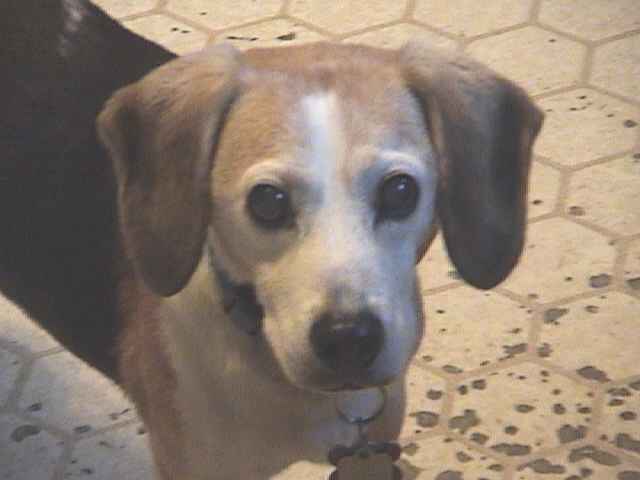
Farewell, Little Sam

We said a last good-bye to our elderly beagle, Sam, today. He'd gone blind and mostly deaf, and was failing in other ways. So we took him to the vet to release him from his body. I believe it was the right thing to do, but it's so hard. Sam had been with us for about eight years. We guessed he was six or seven when we took him in from a family that couldn't keep him, but they had taken him in as a stray, so nobody knew his real age or his past.

He was a big-hearted little guy, though he was also the most trying dog to live with we've ever owned—obsessed with food and prone to accidents in the house. But we loved him anyway. We still remember how he sprang to our cat's defense when a visiting husky went after her: Sam jumped right into the breach and raised holy hell until we got there to intervene. And when Moonlight (the cat) and Hermione (our boxer) got into a tiff over a fallen piece of cold broccoli on the floor, it was Sam who swooped in and gulped it down before either of them could react. And when our kids were first learning piano, Sam and Hermione formed a wonderful Ahhh-ooohhh! chorus.

Sam's on the rainbow bridge now, but here he is with his buddies during easier times.

Labels: ,

Tuesday, July 12, 2005

Byron Preiss (1953-2005)

Science fiction publisher/editor/writer/packager/entrepreneur Byron Preiss died in a car accident last Saturday, while driving to his synagogue in New York. He was a significant figure in the SF publishing world (and not only SF—he published in many areas). I learned of his death from my agent, who said, "It is shocking beyond belief and the entire publishing community is stunned. Although Byron was controversial in many ways, he was a friend, and he left a wife and two young children."

I didn't really know Byron personally—I think I met him only once or twice. But recently he brought out a new edition of my novel From a Changeling Star under his iBooks imprint, and he was planning to do the same with Down the Stream of Stars. Years earlier, I wrote my novel Roger Zelazny's Alien Speedway: Clypsis under the aegis of Byron Preiss Visual Productions. It was a quick project that turned out to be great fun in much the way the Battlestar Galactica novel was, and a project that brought me new readers and more fan mail than I'd gotten from all my other books combined. I had had hopes that he would one day reissue it through iBooks.

Byron had a wife and two daughters, just as I do. One of them was 16 years old—the same age as my older daughter, as of two days ago. That's what hit me the hardest.

There's a fuller tribute to him at comicon.com.

Labels: , , ,